
Founder dominance and leaves it too late to pass over regins and develop next generations
Business Context
- Family-owned business with strong historical success.
- Founder (father, mid-70s) maintains full control over all major decisions.
- Next-generation leader (son, mid-40s) possesses skills, intelligence, and experience but is underutilized and undervalued.
- Founder struggles to relinquish control, is out of touch with current market realities,
and decision-making is overly centralized.
Result: Potential stagnation, unrecognized talent, and risk to business continuity.
Key Issues Identified:
1.Founder Dominance:
All major decisions are controlled by the father, limiting
delegation and slowing innovation.
2.Succession Blockage:
3.Emotional Attachment:
Father cannot emotionally let go, leading to denial of
business realities.
4.Business Risk:
Over-reliance on founder’s judgement can compromise growth and sustainability
Solution / Remediation Plan
Step 1: Acknowledge the Situation
- Arrange a structured conversation facilitated by a neutral third party (family
business advisor or coach). - Frame the discussion around business continuity, growth, and family legacy, not
personal criticism.
Goal: Make the father aware that the status quo risks both the business and the family’s long-
term benefit.
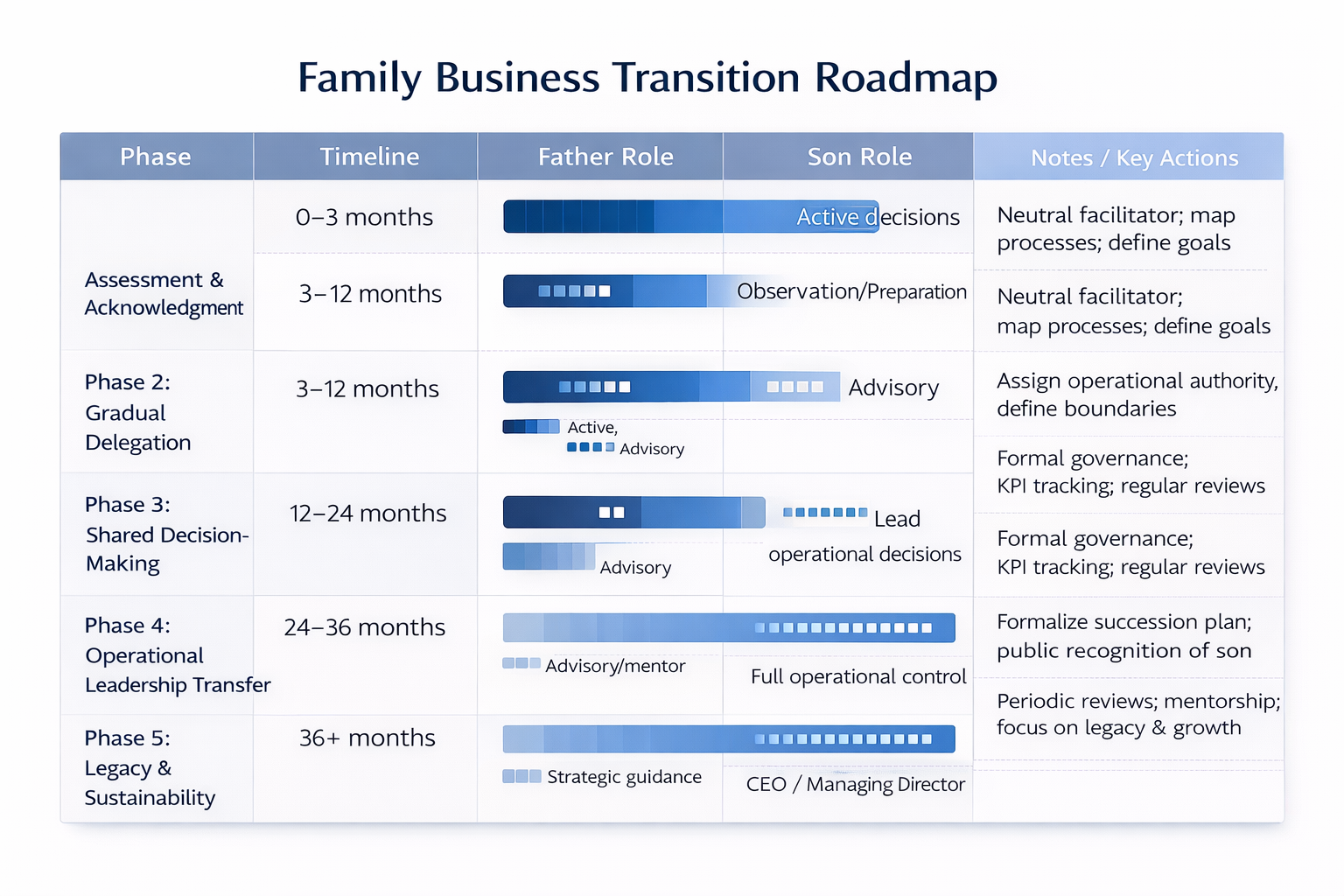
Step 2: Introduce Gradual Transition
Implement a phased delegation plan:
- Identify key areas where the son can take responsibility immediately.
- Allow father to retain oversight but not micro-manage, e.g., advisory role.
Create clear boundaries for decision-making:
- Major strategic decisions: joint discussion.
- Operational decisions: delegated to the son.
- Minor decisions: son autonomy.
Step 3: Formalise Governance
Establish a board or advisory committee, including:
- Independent advisors or mentors.
- Son and Father as members
Introduce formal reporting and performance metrics for key decisions, removing ambiguity about who is accountable.
Step 4: Succession Planning
Develop a written succesion plan:
- Timeline for gradual transfer of leadership
- Defined froles and respomsibilities for both father and son
- Contingency planning for unexpected events
Position the father as Chairman/Founder Emeritus, preserving his legacy while enabling real operational leadership by the son.
Step 5: Emotional & Relationship Support
- Consider Fsamily busines coaching to navigate sensitive dynamics
- Encourage acknowledgement of the son’s contribution publicly, building trust and morale
- Focus on shared vision and legacy, not control,as the emotional lever
Step 6: Monitor and Adjust
Set review milestones every 3–6 months to assess:
- Decision making balance
- Busines perform,ance metrics
- Father-son relationshio dynamics
Make adjustments as needed to ensure the plan is effective and sustainable.
Expected Outcomes
- Son gains operational authority and recognition for contributions.
- Father maintains legacy and advisory role, with reduced day-to-day burden
- Business becomes more agile, relevant,and growth-orientated
- Family relationships improve due to clarityand structures governance
Key Principles
The goal is not to remove the founder, but to transition control responsibly, preserving the
business, the family legacy, and the founder’s dignity.
Client Feedback
“The estate planning process gave us clarity and peace of mind.”
Founder & Majority Shareholder, Family-Owned Business
As a family business owner, I had always put estate planning on the long finger. Working through it properly helped me understand the financial and emotional implications for my family and the business. Everything was structured clearly, tax-efficiently, and in a way that protected both my legacy and my family relationships. I now know that whatever happens, the business and my family are secure.
“Succession planning turned uncertainty into a clear, workable roadmap.”
Chairperson, Second-Generation Family Business
We knew succession was coming, but we didn’t know how to approach it without causing tension or disruption. The structured succession plan allowed us to address governance, decision-making, and timelines in a calm, professional way. It gave confidence to the next generation while allowing the founder to step back without feeling sidelined. The business is now better governed.
“Handing the business to our children was handled with respect and structure.”
Founder, Multi-Generational Family Business
Transferring the business to our children was one of the most emotional decisions we’ve faced. Having an independent, experienced advisor helped us separate family emotions from business decisions. Roles, authority, and ownership were clearly defined, and difficult conversations were managed professionally. The handover strengthened family relationships.